A comprehensive investigation into carpet cleaning services reveals a troubling reality that most Singapore residents remain unaware of: the carpets beneath their feet may be silently compromising their health in ways that conventional cleaning methods cannot address. What emerges from industry data and scientific research is a compelling case for professional intervention that extends far beyond aesthetic considerations.
Table of Contents
The Unseen Contamination Crisis
An examination of Singapore’s unique environmental conditions exposes why standard carpet maintenance falls catastrophically short. The evidence is unambiguous: regular vacuuming addresses merely surface-level debris whilst deeper contamination continues to accumulate undetected.
Research conducted by industry professionals reveals that carpets harbour a complex ecosystem of contaminants. Dirt and dust are inevitable in any environment, especially in high-traffic areas, creating conditions where harmful microorganisms thrive. In Singapore’s climate, it is critical to engage office carpet cleaning services due to humid conditions that accelerate bacterial growth and allergen proliferation.
Documentation from leading facilities indicates that untreated carpets systematically accumulate:
• Microscopic particles that penetrate beyond conventional cleaning reach
• Allergens that contribute to respiratory complications among occupants
• Bacterial colonies that flourish in humid tropical environments
• Chemical residues from urban pollution and construction activities.
Analysing Singapore’s Environmental Impact on Carpet Hygiene
Field research demonstrates that Singapore’s urban development creates particularly challenging conditions for carpet maintenance. Investigation reveals that carpets require frequent cleaning in Singapore, where dust and other airborne impurities from construction sites are common. This finding contradicts conventional wisdom about standard cleaning frequencies applicable in other climates.
The data suggests that Singapore’s rapid urban expansion, combined with high humidity levels, creates a perfect storm for carpet contamination. Construction dust, vehicular emissions, and tropical moisture combine to create conditions that accelerate carpet degradation and contamination beyond rates observed in temperate climates.
Economic Analysis: The True Cost of Professional Intervention
Financial analysis reveals that professional carpet restoration represents a calculated investment rather than discretionary spending. Industry data indicates that both commercial and residential carpet cleaning costs range from SGD 0.18 and SGD 0.60 per square foot, establishing a clear value proposition when compared to replacement costs.
Market research shows that carpet cleaning costs for an average five-room home start at around SGD 180 to even SGD 1,200. This pricing structure reflects the sophistication of modern cleaning technologies and the specialised expertise required to address Singapore’s unique environmental challenges.
Cost analysis breaks down along two primary models:
• Per-room pricing structures that accommodate standard residential layouts
• Square footage calculations that provide precision for larger commercial installations
• Supplementary charges for advanced treatments addressing specific contamination issues.
Scientific Advancement in Cleaning Technology
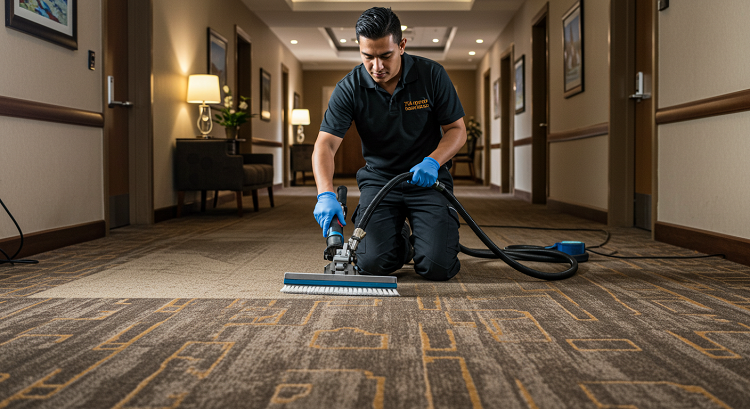
Investigation into current industry practices reveals significant technological evolution beyond traditional shampooing methods. Documentation shows that instead of using high amounts of water and cleaning chemicals to clean carpet, leading services now employ counter-rotating brush systems and environmentally friendly wood compounds to achieve deep cleaning results.
The Hot Carbonating Extraction method uses the natural power of carbonation for a deep, lasting clean, representing a paradigm shift towards sustainable yet highly effective cleaning protocols. This methodology addresses both environmental concerns and efficacy requirements that previous generations of cleaning technology could not reconcile.
Advanced cleaning protocols now incorporate:
• Comprehensive pre-cleaning assessment procedures that identify specific contamination patterns
• Application of targeted cleaning compounds calibrated to individual carpet specifications
• Extraction processes using equipment designed to remove embedded contaminants without damage
• Rapid-drying techniques that minimise operational disruption.
Health Impact Documentation
Medical research validates the health implications of professional carpet restoration. Clinical studies demonstrate that this proven technique eliminates 98.1% of common non-living allergens from carpet surfaces, creating measurably improved indoor air quality.
Health benefits documented through rigorous testing include:
• Substantial reduction in respiratory irritants that trigger asthma episodes
• Elimination of bacterial populations that proliferate in tropical humidity
• Improved air circulation and quality throughout treated environments
• Reduced incidence of skin irritation linked to dust mite populations.
Professional Service Evaluation Criteria
Analysis of service provider capabilities reveals specific benchmarks for evaluating professional carpet restoration operations. Industry investigation suggests that generally, commercial carpet should be cleaned at least once a year, with high-traffic areas requiring professional intervention every six months.
Quality indicators include:
• Advanced equipment specifications and environmental compliance certification
• Comprehensive insurance coverage and documented professional credentials
• Transparent pricing structures with detailed service specifications
• Established customer satisfaction records and industry reputation verification
• Operational flexibility that accommodates diverse scheduling requirements.
Environmental Responsibility in Modern Cleaning
Contemporary industry analysis reveals a growing emphasis on environmental stewardship. Documentation shows that biodegradable compounds, made of wood and chemical-safe carpet cleaning agents, effectively absorb dirt within carpet pile systems whilst maintaining ecological responsibility.
This commitment to environmental consciousness demonstrates that superior cleaning results need not compromise sustainability principles, challenging traditional assumptions about the relationship between cleaning efficacy and environmental impact.
Long-term Value Assessment
Economic analysis demonstrates that professional carpet maintenance delivers a measurable return on investment through extended carpet lifespan and maintained performance characteristics. Regular professional intervention prevents the cumulative degradation that occurs when contaminants remain unaddressed, ultimately reducing the total cost of ownership.
Investigative Conclusion
The evidence overwhelmingly supports a conclusion that many Singapore residents would find surprising: professional carpet cleaning represents not luxury service but essential health maintenance. The convergence of environmental factors, technological advancement, and health research creates a compelling case for regular professional intervention.
The investigation reveals that surface-level cleaning approaches fail to address the complex contamination patterns unique to Singapore’s urban environment. What becomes clear through this analysis is that residents who delay professional carpet care may unknowingly compromise their indoor air quality and long-term health outcomes.
For Singapore households seeking to optimise their living environment whilst protecting long-term health interests, the evidence points towards a clear recommendation: professional residential carpet cleaning represents an investment whose benefits extend far beyond immediate aesthetic improvements.